Search This Blog

Friday, 6 January 2012

Secondary Research

Women gamers now outnumber men who play games- and they're not sticking to just games of the "female centric" casual and social variety.
A 2011 study by market research firm Interpret LLC, showed that console use amoung female gamers had increased "significantly" in the previous two years. Some 21% of women gamers had used an Xbox 360 and 16% had used a PS3. A surprising, 44% preferred genres other than casual, excercise and music/rhythm.
Marketers aiming at women gamers should understand that they exhibit different attitudes than men do. Courtney Johnson, Interpret analyst, said in a statement, “They are much more likely to prefer to play solo than men, and play games for less competitive and more narrative- and character-driven reasons.”
Women came out ahead in a comScore Media Metrix study of who plays online games. The study, which included browser-based online games but not social games, demonstrated that about 48 million females vs. about 47 million males played them.
While males tend to represent a larger percentage of unique visitors to gaming sites among younger age groups, once people hit 35, the percentage skews toward females.
While women’s interest in games is diversifying, their enjoyment of social games is still high. As PopCap Games results from September 2011 showed, more women indulge their love of FarmVille and Diner Dash than do men.

Sunday, 11 December 2011

Role Models


Our first video sees Ryan Gavan interviewing Hayley McGroarty, they are talking about the issue of role models within games and society itself. 


Thursday, 8 December 2011

Interview Questions

Do we see life through our phone?
The world of 'new media' is thriving, and so our group has decided to take a different spin on researching. We will compile a series of video interviews, using class members, lectures and friends. Asking people the following questions:


Applied Media Research- Rebel Play

Do media platforms and genres have specific gender appeal? Why don’t more women play console games?

Questions

1.       When you were younger, who was your role model?

2.       What kind of impact did/do celebrities have upon you?

3.       Do you prefer the video game, Lara Croft. Or the film?

i)                    Why?

4.       Have you ever been offended by female stereotype on screen?

5.       What type of games do you play?

6.       Do you ever pay for games?

a)      If no, why not?


7.       Please rate these from 1-5 as to what you are more likely to spend money on?

(1 being most)

a)      Handbag

b)      Game

c)       Jewellery  

8.       What type of media do you use in your everyday life?

9.       a) Who do you want to win the X-Factor?

b )Why?

Thursday, 17 November 2011

Choosing a method

Is it a family affair?


The aim of this project is to provide an academic study of one of the industry level questions which have been discussed thus far.  By constructing small groups of three, we will concentrate on one of the questions and aim to provide a detailed and informed research study surrounding one question.
We have talked a lot about varying research methods during a lecture, these take form under two categories:

Quantative and Qualitative as well as Primary and Secondary data collection

It is important, I feel, to gain an understanding of how to use these methods correctly and for them to support/ develop the study of the hypothesis which will be constructed.

The question that my group are going answer is

Do media platforms and genres have specific gender appeal? Why don't more women play console games?

After having a group meeting we discussed some of the key areas that we would look at:

  • Role models for young girls, provided on television shows and reflected in games such as Grand Theft Auto and the derogatory image of women only being portrayed as prostitutes. Does this negative representation have a key impact or does is this simply over looked and are young girls having to look towards celebrities/ in more recent months royalty for a positive role model?
  •  The history behind women's role within society, we want to find out/ look into the 'Hunter and Gatherer' theory, and focus on the stereotypes as well as the social norms within the gaming industry. Are females discouraged to use online gaming platforms because they are filled with testosterone fuelled men who favour violence and vulgarity. We should also look at the issue of violence within games, are these the only games that become popular and is it simply because they create a sense of escapism. Whereas females generally favour games that will help to improve skills?
  • Linking closely with the social side, we want to focus on the family side. Is it simply a case of the person and not the gender? 
  • As well as the advertising, do platforms such as the Nintendo Wii use specific individuals to sell the product? We will look to analyse some of the campaigns that a variety of companies use. 
  • It is also interesting to look at the technology behind it, as it is becoming common for users to create their own avatar. Why is this? How did the need or recognition for this change become apparent? 
  • One key thing to consider is whether any of the information exists? Have gaming companies done research into the problem of gender appeal and neglect? 
It is important as a group that we conduct academic research, which will done using LJMU online journals because these are generally up to date. 

The next stage of our research is to create and circulate a questionnaire, I also believe that online surveys can be very beneficial.

Sunday, 6 November 2011

Children are the future?


"How can we create a safe environment for children without discouraging participation?"


Jim Fleming from the Childrens department at the BBC, CBBC, is determined to deliver a safe online platform for children however, in a world of increased "stranger danger" and fear on the Internet, is this even possible?
The safe age for children to join most social networking sites is 13, these days however it could be suggested that children as young as 7 have access to devices that allow for these applications to run. Whilst working for a summer camp in America I ran into this demographic head on, it is strictly prohibited for the children to have any electronic devices for the time that they are there which is why it shocked me so much when kids would hand in their two iPhones (one is usually a dummy) and their new iPod. It is so easy to access the world wide web, but due to legality issues the BBC cannot even reach out to the young "Facebook generation" because they shouldn't even legally be on there.
Which is why this question has been formed, there is a huge gap in the market from when children lose interest in CBBC to when they can legally be on social networks and Jim Fleming is trying to fill this gap. Is there also a gap within the transition from Cbeebies to CBBC?
With the success of social networking sites (SNS) such as Facebook, Twitter, Tumblr, StumbleUpon, CBBC needs to be relevant and engaging for children. It needs to offer 3 core elements; personalisation, interactivity and communication. However, with increased personalisation and communication comes risk. If you look closely at range in multi-media devices from the television, interactivity, games consoles to social networking, there is an increase in risk and a decrease in parental control. There is an enormous leap from innocent child orientated sites to the online social networks.
There is an important question that needs to be asked, why do people use social networks?
In the beginning sites such as Bebo and MySpace formed the foundation of social networking, they were seen very much as a tool for sharing information as well as communication.
The first social networking site was established in 1997:
Social Networking Timeline

The diagram above clearly shows that around 2005 there was a boom in SNS, it was also the year that YouTube materialised, which is the largest video sharing site closely followed recently by Vimeo. 
It's the idea of creating a network of friends and being able to communicate 24/7, and this is the biggest pulling factor that even the internet itself has to offer. 
CBBC clearly recognise the pull of SNS and the comfort and danger that they present, they look to allow children to  have safe access to an online and interactive platform. But is this even possible? Youngsters want to be able to connect with people, talk about what interests them, play games and learn. They don't want to feel like they are alone, they want to become part of the technological age.  One idea that Jim Flemming had was using profile pages, which would allow children to customise their own page and display high scores on games. The need for regulation would be even more important in this instant, making sure children do not divulge personal information or pictures to strangers will be very important. This makes it very difficult to provide a sense of freedom and inclusion, and so would a personal profile page work? How will they monitor age restrictions and will it become harder if the quantity of children using the site increases dramatically? 

I feel that the only way to create a space that children want is to ask them, possibly run a competition on the CBBC channel. If they are truly motivated to create such a site then including children is key, not only would it stimulate creativity but it may be an easier solution to the issue. The problem with creating an extended social media world is that the internet itself is dangerous and parental control is down to parents, and how much attention they pay to what their children are doing online.

Monday, 17 October 2011

The Hunter and Gatherer

"Do media platforms and genres have specific gender appeal? Why don't more women play console games?"

Is there a social element to consider?


In this weeks Applied Media Research lecture we were joined by Rebel Play game publishers. They came in to discuss the reason why women don't play games consoles. However, according to statistics around 58% of gamers are men leaving the other 42% to be women. So is this merely a preconception? An article from the BBC goes further in discussing this "Would all women gamers please stand up!". It talks about how it is easy to assume that women don't play video games, due to stereotypes and certain gender ideals which have been created over time. To begin with you have to think about the aesthetics of gaming, are they important? For example many of the consoles out right now are either black or white, is there a reason for this? Are white consoles supposed to appeal to women more, or is this too merely a preconception. Another thing to look at are the controllers, from a personal perspective I often find the xbox controllers too complex, with the need for specific finger placement for some games it is hard to learn the combinations unless you are a die hard xbox fan, not only because all of there controllers are similar but because some games require a beforehand knowledge. Advertising also has a lot to do with this, the use of female hands in the Nintendo Wii adverts suggests that this product is for women and on the flip side, does this make men less inclined to buy this product? Therefore does this question require the need for a psychological interpretation, is there something at gaming companies can do about this?
From a woman's perspective I have my own reasons for not gaming, this is not to say that I haven't gamed and won't do so in the future. However for me gaming does offer a sense of achievement, it is almost true to say that it offers this kind of euphoric feeling, one of my proudest moments a few years ago was when I completed Fable II. This is the only game I have ever completed and looking closely at Fable II it offers a multi-sex user platform whereby you choose whether to be male or female. This worked for me, but did it work on a more universal level and so is this a format that works?
When Fable III finally came out and offered the same option of choosing your player it changed the basic playing process, it began to show the journey of your player along a path at the end of each challenge and in doing so it (for me) became much too achievement based.
This is another suggestion as to why more women do not play console games, most games are founded on this "sense of achievement" and that after spending a whole day fighting off army zombies you will/should gain some kind of prize. One thing that Rebel Play said was that women prefer to 'waste time' on something that will help gain skills for life, which is why intellectual social games such as Bejewelled has such a huge potential market. The male population will use gaming as a kind of social achievement eg. who will finish the new Call of Duty game first or, who will unlock the new level and so on. There is also online gaming which is hugely popular and interconnects players all over the world, this allows gamers to play against their friends and in a sense their "enemies", this web of players also pushes out this negative male dominated stereotype and in doing so, does this push away potential female gamers?
Why do people play games?
Is it due to "Sticky games", boredom, pursuit of  fun (specific), a pattern recognition (storyline)?

Here is an interesting video about gaming and although it is fairly unrelated to this question (although the fact that it is presented by a women is highly interesting). She talks about the importance of gaming itself and this sense of euphoria.


At one point in the presentation evolutionary psychology came into question, and after conducting some secondary research into this I found an article titled  "Women in Games" whilst this isn't the most informative document it touches upon the hunter-gatherer theory and it explains "how our behaviour is driven by three forces, with the cultural element dominating in a great many situations- but not all." This theory notes how men are drawn into shooting games due to skills gained in prehistoric times whilst hunting for food, and so they are better at focusing on long distant targets. Whereas women are better at seeing things that are in front of them, which is suggested why they focus on a more immediate response with a good and positive outcome that improves their life skills.

Going back to the question itself and linking it with University, what number of students are currently enrolled into creative media courses and is this a problem for the future of gaming, Rebel Play stated that the problem with getting more women playing games is directly linked to the fact that there are very few women in the gaming industry. Therefore would it beneficial for a company such as Rebel Play to infiltrate the local/national Universities and conducting focus groups or workshops with a sample of female digital media students. 
Another key point to assess is the change in technology, it has become far less computational and is now offered on a widely available level, the attitude to technology has also changed it has become an integral part of society.

One final statistic to consider is that the biggest emerging market in gaming is women over the age of 18, and so is the problem simply in how games are trying to appeal to women, are they put off by the rise and repeat element or are the mechanics of the game a turn off? 
I believe that there is a problem somewhere and it lies within the educational element of gaming, more needs to be done about positively representing the gaming industry and therefore reconstructing those archaic ideologies.


Tuesday, 11 October 2011

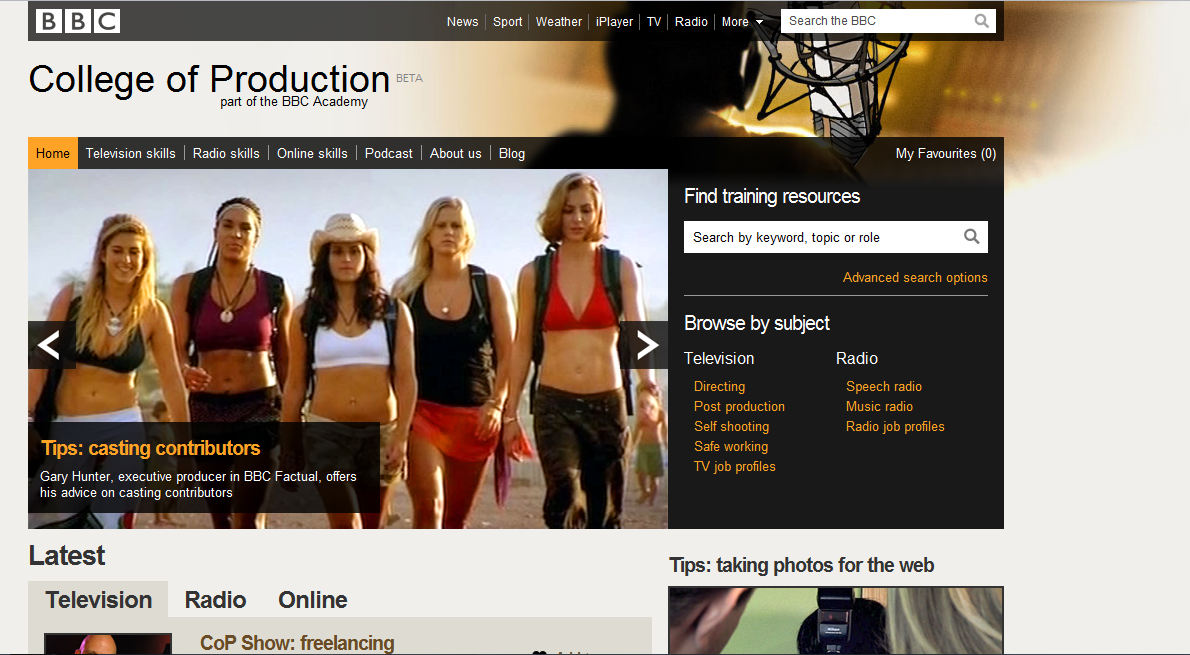
BBC College of Production


This is a useful resource which I thought I should share with you. It's called the College of Production and it is run by the BBC Academy.