Search This Blog

Monday, 17 October 2011

The Hunter and Gatherer

"Do media platforms and genres have specific gender appeal? Why don't more women play console games?"

Is there a social element to consider?


In this weeks Applied Media Research lecture we were joined by Rebel Play game publishers. They came in to discuss the reason why women don't play games consoles. However, according to statistics around 58% of gamers are men leaving the other 42% to be women. So is this merely a preconception? An article from the BBC goes further in discussing this "Would all women gamers please stand up!". It talks about how it is easy to assume that women don't play video games, due to stereotypes and certain gender ideals which have been created over time. To begin with you have to think about the aesthetics of gaming, are they important? For example many of the consoles out right now are either black or white, is there a reason for this? Are white consoles supposed to appeal to women more, or is this too merely a preconception. Another thing to look at are the controllers, from a personal perspective I often find the xbox controllers too complex, with the need for specific finger placement for some games it is hard to learn the combinations unless you are a die hard xbox fan, not only because all of there controllers are similar but because some games require a beforehand knowledge. Advertising also has a lot to do with this, the use of female hands in the Nintendo Wii adverts suggests that this product is for women and on the flip side, does this make men less inclined to buy this product? Therefore does this question require the need for a psychological interpretation, is there something at gaming companies can do about this?
From a woman's perspective I have my own reasons for not gaming, this is not to say that I haven't gamed and won't do so in the future. However for me gaming does offer a sense of achievement, it is almost true to say that it offers this kind of euphoric feeling, one of my proudest moments a few years ago was when I completed Fable II. This is the only game I have ever completed and looking closely at Fable II it offers a multi-sex user platform whereby you choose whether to be male or female. This worked for me, but did it work on a more universal level and so is this a format that works?
When Fable III finally came out and offered the same option of choosing your player it changed the basic playing process, it began to show the journey of your player along a path at the end of each challenge and in doing so it (for me) became much too achievement based.
This is another suggestion as to why more women do not play console games, most games are founded on this "sense of achievement" and that after spending a whole day fighting off army zombies you will/should gain some kind of prize. One thing that Rebel Play said was that women prefer to 'waste time' on something that will help gain skills for life, which is why intellectual social games such as Bejewelled has such a huge potential market. The male population will use gaming as a kind of social achievement eg. who will finish the new Call of Duty game first or, who will unlock the new level and so on. There is also online gaming which is hugely popular and interconnects players all over the world, this allows gamers to play against their friends and in a sense their "enemies", this web of players also pushes out this negative male dominated stereotype and in doing so, does this push away potential female gamers?
Why do people play games?
Is it due to "Sticky games", boredom, pursuit of  fun (specific), a pattern recognition (storyline)?

Here is an interesting video about gaming and although it is fairly unrelated to this question (although the fact that it is presented by a women is highly interesting). She talks about the importance of gaming itself and this sense of euphoria.


At one point in the presentation evolutionary psychology came into question, and after conducting some secondary research into this I found an article titled  "Women in Games" whilst this isn't the most informative document it touches upon the hunter-gatherer theory and it explains "how our behaviour is driven by three forces, with the cultural element dominating in a great many situations- but not all." This theory notes how men are drawn into shooting games due to skills gained in prehistoric times whilst hunting for food, and so they are better at focusing on long distant targets. Whereas women are better at seeing things that are in front of them, which is suggested why they focus on a more immediate response with a good and positive outcome that improves their life skills.

Going back to the question itself and linking it with University, what number of students are currently enrolled into creative media courses and is this a problem for the future of gaming, Rebel Play stated that the problem with getting more women playing games is directly linked to the fact that there are very few women in the gaming industry. Therefore would it beneficial for a company such as Rebel Play to infiltrate the local/national Universities and conducting focus groups or workshops with a sample of female digital media students. 
Another key point to assess is the change in technology, it has become far less computational and is now offered on a widely available level, the attitude to technology has also changed it has become an integral part of society.

One final statistic to consider is that the biggest emerging market in gaming is women over the age of 18, and so is the problem simply in how games are trying to appeal to women, are they put off by the rise and repeat element or are the mechanics of the game a turn off? 
I believe that there is a problem somewhere and it lies within the educational element of gaming, more needs to be done about positively representing the gaming industry and therefore reconstructing those archaic ideologies.


Tuesday, 11 October 2011

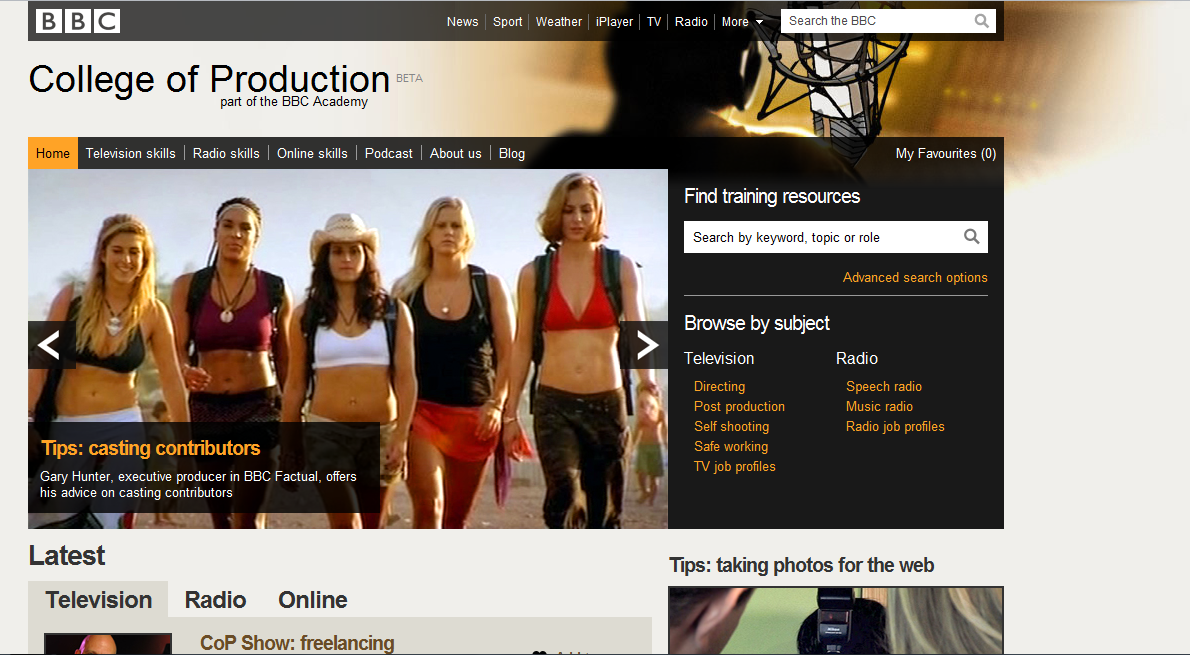
BBC College of Production


This is a useful resource which I thought I should share with you. It's called the College of Production and it is run by the BBC Academy.

Sunday, 9 October 2011

Convergence Culture

In this weeks lecture we were joined by one of Liverpool's top film production companies, Hurricane Films. As part of our Applied Media Research module at LJMU they presented us with a question:

How can you engage an on-line audience in story telling?- How do you encourage users, especially those from an older generation to participate?

This is related to Hurricane Films project called Peoples Stories

This is an online operation to share stories from the older generation within Merseyside before they are lost forever. It follows their earlier film 'Of Time and The City' which Solon Papadopoulos and Roy Boulter of Hurricane Films produced. 

The first thing that you have to consider about trying to reach this older generation is that, it will always be harder for them to become aware of the site due to their lack of knowledge surrounding the internet itself. Therefore the first question that should be asked is how many people over the age of 60 actually use the internet? Without conducting any initial quantative research it is easy to conclude that this number will be proportionality small. So how do you reach that population? There were several ways that were discussed in the presentation:
  • Actively go out into the community and record their stories by going to community centres, whether that is by filming the subject or having them write or tell you their specific story.
  • Appealing in the local newspaper by writing an advert/story
  • Going into the local museum/ working along side them
  • Simply using old media such as photographs, paintings and videos

A few things that I have thought of since the presentation would be going into primary or junior schools and working with them to find a story about their family history or organize a festival all about the project where they physically come to you and tell you their story. Although like always there will be pro's and con's to this such as; would anyone come to it? Are some stories already lost in history? 


Looking more specifically at the Peoples Stories website, are their any barriers to its interface such as logging in/ registering due to a lack of an email address for example. However the content on the site is accessible without a user profile and so this makes it an open source for everyone. One thing that was brought up was user testing of the website before it goes live, and thus allowing problems or patterns to become recognised and solved. 

The key aim of this project is to create a platform for sharing, and past example of this concept is Ridley Scott's 'A Day in the Life' where people from around the globe share what happened on one specific day:


Peoples Stories allows everyone a resource for telling their story and as long as you give them a reason why they want to share it, 90% of the time they probably will. Like 'A Day in the Life' it gives you the chance to become part of history. 

 A final thought that I had on the afore mentioned question was surrounding the future of this project, will it become extinct 50 years from now because there is so much information about 'now' on the internet or will this project become even bigger. Will it encourage to-days youth to film the now, for archives in the future?


Thursday, 29 September 2011

Media Professional Studies

My first blog is about my life surrounding media. My interest in technology formed the foundations for becoming infatuated in the media world, however to start with I had to understand what the word 'media' meant to me. Is it getting up in the morning and knowing that there is a whole world floating around with so much information? Looking at this further, it's clearly up to you how you access this "world" but for me it's via an online platform.
I began studying media for my A-Levels, my reason for choosing this subject; I knew that one of the projects on this course was in making a film trailer. I love films and the way that they create this whole new world, one that you can delve into and become infatuated by the visuals, story and most of the time, the acting. One thing that my first Media Studies teacher said to me will always stick in my head, she said that "This course will ruin the way you will look at films from now on." A part of this is true but over the years I have reworded her statement..."Media Studies will change the way you look at the world", this has now become a moto for my professional career in Media and it's not only true for films because it can be transferred to every media platform. Looking back at this class I didn't really anticipate the other 95% of it, with which we would look at the textual analysis of films and print media. In hindsight I think I thrived more within the theoretic aspect. I loved looking at the theory of how things began and how it has aged over the years and of course looking at critically analyzing the how's of why's of this.
I have done a lot of projects surrounding media, I love photography and images and I enjoy filming things and then spending hours editing and fine tuning it, so that I can share it with the world. Which brings me back to my first ponderings about what media is to me, it is all about sharing. Whether you are sharing information, images or videos.
The course at Liverpool John Moores blew me away as soon as I researched all about it, from the online and digital aspects to the critical thinking and finally to the creative side.
In year one of this course we delved into the documentary spectrum, my groups looked at and addressed local issues in Liverpool:


As well as profiling one of Liverpool's most up and coming DJ's:


University is all about work experience and I really think that it helps you to "get your foot in the door"- so to speak. I worked with a couple of companies such as 'Geek Chic' where I helped with live projections.
In the future I would be looking to combine all of my experience and creativity so that I can find 'the perfect job', I am not sure what field specifically but until then I am hoping to get an intership with the BBC or any other mainstream media mogul.

The way I use media as both a consumer and producer is watching films and television, my online profile  on many of the social networks and also broadcasting all of my videos to YouTube.

http://www.youtube.com/user/lauharrington1?feature=mhee

Sharing information with the rest of the world really. Isn't it?